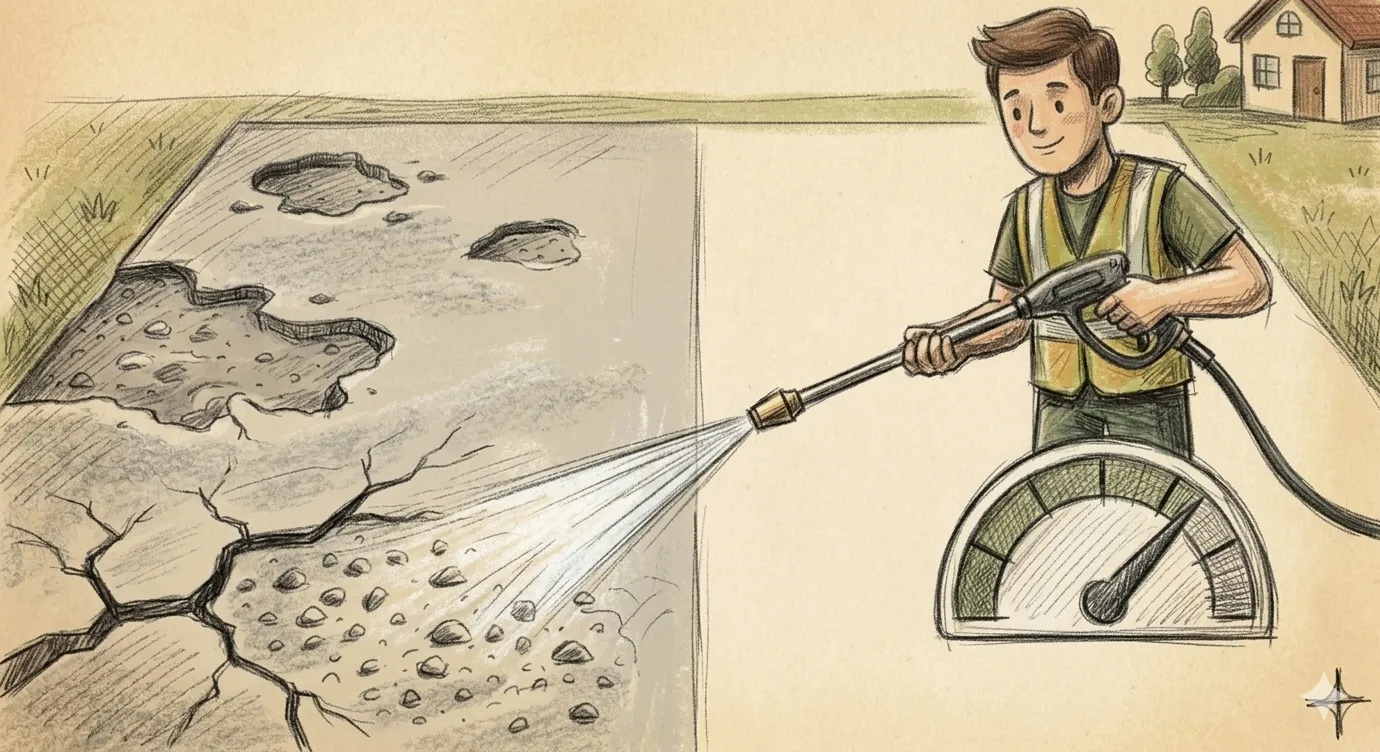
You’ve seen the satisfying videos—years of black grime vanishing under a roaring spray, leaving behind a driveway that looks brand new. It’s tempting to rent a machine and blast away, or hire the cheapest crew on the block. But if you’ve ever paused and asked yourself, “Can pressure washing damage concrete?”, you’re already thinking like a smart homeowner. The short answer is yes, absolutely. When done wrong, pressure washing doesn’t just clean concrete—it can permanently scar, pit, and weaken the surface. The good news is that with the right technique (or the right professional), you can erase years of filth without causing the dreaded “etching” that leads to costly repairs.
This article explains exactly how concrete gets damaged during pressure washing, what concrete etching looks like, and the 7 rules every operator—DIY or pro—must follow to avoid destroying your driveway, patio, or walkway.
How Pressure Washing Damages Concrete: The Science of Etching
Concrete is rugged, but it’s not indestructible. The top layer, called the “cream,” is a thin, dense paste of cement and fine sand that cures to form a smooth, closed surface. Beneath it lie larger aggregates (stones) and a more porous matrix. When pressure washing is too aggressive, you strip that protective cream away—a process known as surface etching.
What Does Etched Concrete Look Like?
- A rough, sandy texture where the smooth top layer used to be
- Exposed small pits that collect dirt faster than before
- Visible “lines” or swirl marks following the path of the wand
- A patchy finish, often lighter in color where the cream has been blasted off
- Standing water in depressions that didn’t exist before (because the concrete is now uneven)
Once the cream is gone, the softer underlayer absorbs stains, moisture, and freeze-thaw damage more readily. What started as a “deep clean” can shave years off the life of your flatwork.
The 3 Pressure Washing Mistakes That Cause Concrete Damage
Understanding can pressure washing damage concrete starts with pinpointing what actually triggers the failure:
1. Excessive PSI (Pounds per Square Inch)
Most household pressure washers produce 1,500–3,000 PSI. Professional gear can climb to 4,000 PSI or higher. Older, weaker concrete or poorly cured slabs can begin to erode at just 2,500 PSI if the nozzle is too close. A safe cleaning normally sits between 2,500 and 3,000 PSI with the right distance, while extremely tough commercial concrete might tolerate more—but “more” is almost never the goal.
2. Wrong Nozzle Tip and Zero-Degree Sprays
The red 0° nozzle turns water into a concentrated blade. A single pass too close will carve a permanent stripe into the surface. Even the 15° (yellow) tip can etch if held directly above the concrete for too long. Wide fan tips (25° or 40°) spread the force, dramatically reducing the risk.
3. Holding the Wand Too Close
Distance is safety. A turbo nozzle or tight fan tip held 2 inches from the slab multiplies the effective pressure exponentially. Backing away to 6–12 inches allows the water energy to dissipate. Professional operators use a consistent stand-off distance and keep the wand moving at all times—lingering is what dooms a slab.
Can You Avoid Etching Entirely? Yes—Here’s How
Whether you’re a DIY warrior determined to do it yourself or you’re vetting a contractor, these non-negotiable rules will protect your concrete from pressure washing damage.
1. Use a Surface Cleaner for Large Flat Areas
A rotary surface cleaner (that round disc with spinning nozzles) is the single best guard against etching. It maintains a fixed, safe distance from the slab and distributes pressure evenly over a much wider area. The consistent swirl pattern it leaves dries uniformly, leaving zero wand marks. If you see a professional arrive without one for a driveway, ask why.
2. Stick to 25° or 40° Fan Tips Only—Never Red or Yellow on Concrete
The white 40° nozzle and green 25° nozzle are your workhorses. They clean effectively at 2,500–3,000 PSI while keeping the impact gentle enough to preserve the surface cream. For stubborn spots, pre-treat with a concrete cleaner instead of tightening the spray angle.
3. Pre-Treat, Don’t Overpressurize
High pressure shouldn’t be your primary cleaning mechanism—chemistry should be. Apply a biodegradable degreaser or sodium hypochlorite solution (for organic stains like mold and algae) and let it dwell for 5–10 minutes. The chemicals do the heavy lifting, so you only need enough pressure to rinse the soil away—or use soft washing on delicate stamped or sealed concrete. This single shift prevents most concrete damage.
4. Maintain a 6–12 Inch Distance and Keep the Wand Moving
Imagine spray painting; you wouldn’t hold the can in one spot. The same applies to a pressure washer wand. Move steadily at about 1–2 feet per second and overlap each pass slightly. If you see aggregate pebbles start to appear, stop immediately—you’ve already begun etching.
5. Test an Inconspicuous Corner First
Concrete varies. A 15-year-old driveway that has seen deicing salts may flake under pressure that a new patio shrugs off. Pick a hidden spot, start with low pressure and a wide nozzle, and only ramp up if the surface responds well.
6. Never Use High Heat or a Power Washer Without Adjusting Pressure
“Power washing” uses heated water; “pressure washing” does not. Heat can accelerate chemical reactions and sometimes soften certain sealers or coatings, making the surface more vulnerable to impact. If your machine heats water, be extra conservative with pressure settings.
7. Reseal After a Deep Clean
Concrete that’s been pressure washed—even perfectly—is slightly more porous until it’s sealed again. Applying a penetrating silane-siloxane sealer or an acrylic cure-and-seal after cleaning locks out moisture, salt, and future stains, while also hardening the surface against next time.
DIY vs. Hiring a Professional: The Hidden Risk No One Talks About
You can absolutely rent a 4,000 PSI machine and follow the rules above. But the “hidden risk” isn’t technique alone—it’s liability. A single etched driveway can cost 3to8 per square foot to resurface or replace. For a standard two-car driveway, that’s easily 1,500–4,000. Most rental yard damage waivers don’t cover structural damage to your own property caused by misuse.
A trained professional arrives with:
- Commercial-grade rotary cleaners that won’t gouge
- Pre-mixed cleaning solutions matched to the stain type
- An understanding of how old vs. new concrete responds
- Full insurance coverage in the rare event something goes wrong
When homeowners ask us, “Can pressure washing damage concrete?” what they’re really asking is, “Is it safe for me to do this myself without ruining my driveway?” Our answer is always honest: it’s safe if you know exactly what you’re doing and have the right equipment. If there’s any doubt, the cost of hiring a vetted pro is almost always cheaper than the repair bill that follows a single misjudged pass.
Don’t Let the Wrong Technique Ruin Your Driveway
Pressure washing is still the most dramatic and cost-effective way to restore concrete. The difference between a 10-year revival and an expensive etching mistake comes down to knowledge, patience, and respect for the surface. Now that you know the answer to “can pressure washing damage concrete” and exactly how to avoid it, you can approach your next cleaning with confidence—or hire a team that treats your concrete like their own.
If you’re in La Vernia, TX and want driveway or patio cleaning without the gamble, request a free estimate today. We use adjustable pressure systems, commercial rotary cleaners, and years of concrete-specific training to remove stains without etching a single inch of your slab. Your concrete deserves clean, not scarred.